
Neuroscience backed techniques within a humanistic approach
At the core of my practice is the Humanistic philosophy. We believe that every individual possesses an innate drive toward growth and self-healing. Therapy is not about “fixing” what is broken, but about removing the obstacles that prevent you from reaching your full potential.
-
Core Principles: Empathy, non-judgmental acceptance, and the belief that you are the expert of your own experience.
-
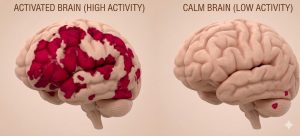
The Goal: To move from a state of internal conflict (the activated brain) to a felt sense of peace (the calm Brain).
1. Gestalt Therapy: The Power of “Now”
Gestalt is a holistic approach that focuses on our experience in the present moment and considers that we have 3 centers from which we process our lives: our mind, emotions and instincts. When these 3 are aligned, we live in harmony. Instead of simply talking about a problem, we explore how that problem lives in our centers: our current thoughts, feelings and sensations.
-
How it heals: It helps us close “unfinished business”— releasing past emotional wounds that keep our brain in a state of chronic alarm.
2. Mindfulness & Self-Compassion (MSC)
Mindfulness is the practice of kindly expanding awareness and acceptance of the present moment, without judgment. Self-Compassion is the practice of cultivating kindness to the one experiencing the moment, especially when going through difficult experiences.
-
How it heals: By quieting the inner critic, self-compassion teaches us that we no longer need to stay on guard. When we calm that inner voice that feels so punishing, we allow our mind and body to feel the relief of being cared for with gentleness—reclaiming the safety that was missing in our past and providing it for ourselves today. In this harmonious state, we can truly thrive, repairing the old wounds of not feeling ‘good enough’ and helping us to finally feel that we are deeply valued and worthy —which is our birthright.
3. Aleces, Trauma Reprocessing and Reintegration Model
Created by Mario Salvador and Carmen Cuenca, the ALECES model emphasizes the therapist’s resonance, attunement, and presence as the essential foundation for biological safety. Through a process of deep listening—attending not just to words, but to the subtle language of the body and the nervous system—it facilitates the natural reprocessing and integration of traumatic experiences.
-
How it heals: The goal is not only to unburden repressed, suppressed, or ignored emotions and sensations but also to reintegrate the various parts of the personality (our old patterns, behaviours and beliefs), allowing them to heal at a deeper level and return to a state of wholeness within an integrated Self.
4. Internal Family Systems (IFS)
It views the mind as a system of “Parts” (the perfectionist, the impatient, the demanding, the people-pleaser, the inner child, etc.). Often, these parts are in conflict, causing m- – ental exhaustion and relational problems.
We often mistake our defensive strategies for who we truly are. We aren’t ‘broken’ or ‘bad’; we simply have reactive parts that took over to protect us from past pain. These parts might lash out, attack us from within, or force us to withdraw—but they are not our true self. Healing begins when we stop fighting these protectors and start leading them with compassion, allowing our true Self—calm, confident and clear—to finally take the wheel.
-
How it heals: It help us access our Core Self—a place of natural calm and curiosity—to lead and harmonize our internal “family” of parts.
5. Somatic Experiencing (SE)
Trauma and chronic stress aren’t just in our head; they are “stuck” in our nervous system, which is thread that weaves our entire organism together. It connects our thoughts to our heartbeat and our emotions to our muscles. Because this happens throughout the whole organism, we can’t just ‘think’ our way out of stress. We have to help the body feel safe again so the entire system can return to balance.
When we experience a threat—which can be as simple as someone’s anger, a cold look, an emotional withdrawal or rejection—the whole organism reacts and our nervous system chooses one of these 4 modes to keep us safe and protected from pain:
-
Fight or Flight (The Alarm): Our heart races and we feel restless or angry. Our body is pumping energy to either “fight” for the relationship or “run away” from the conflict (Sympathetic nervous system activation)
-
Freeze (The Stuck State): We feel numb or “paralyzed.” We might be physically still, but our heart is racing inside. We’re like a deer in headlights—unable to speak or move, feeling “trapped” (Sympathetic N.S. activation)
-
Shut Down (The Disconnection): If the pain is too much (a loved one never fulfills our emotional needs), our system “pulls the plug” to numb us. We feel foggy, exhausted, or like we,ve “checked out” from the room. It’s a way to not feel the blow (Parasympathetic nervous system activation -rest and digest-)
-
Fawn and Appease (The People-Pleaser): This is a clever survival trick. To avoid conflict, we immediately try to make the other person like us, make them happy. We ignore our own needs, say “sorry” even if it’s not our fault, and “merge” with their emotions just to stay safe. In the appease response, we might be feeling a bigger threat. Internally, our heart is racing with anxiety (Sympathetic), but externally, our body forces a calm mask (Parasympathetic) to please the other person. (A mixture between sympathetic and parasympathetic activation is on)
How our survival energy stays “Stuck”
“Trauma is the ‘survival charge’ that never left our body. Whether we reacted by fighting, freezing, or appeasing someone to stay safe, that energy stays locked in our nervous system long after the person left the room. For years even.
Somatic Experiencing helps our body finally finish those old survival responses. It teaches our system that we don’t have to ‘shut down’ or ‘fawn’ anymore to be okay. It’s about moving from a state of constant protection back into a state of authentic connection and peace.
-
How it heals: It allows our body to complete its natural “fight, flight, freeze, fawn or appease” cycles, returning our nervous system to a state of confidence, safety and equilibrium.
Again, through relational attunement and resonance, we create a shared field of safety. This environment allows our organism to finally explore its survival responses and gives the body the space it needs to complete them, moving from a state of protection back into a state of freedom and connection.
6. Brainspotting (BSP)
“Where you look affects how you feel.” Brainspotting works by identifying ‘Brainspots’—eye positions that correlate with the internal activation of a traumatic or emotional issue. Once a spot is found, it acts as a doorway to the subcortical brain, the area responsible for survival, emotional regulation, and deep healing.
By holding our gaze on these spots, we allow the brain to process trauma from the bottom-up * (subcortical brain to subcortex). Instead of just talking about the problem, we give the nervous system the focused space it needs to reorganize itself, releasing the physical and emotional ‘load’ that has been stuck for years.
-
How it heals: It bypasses the rational mind to access the deep, subcortical brain where traditional talk therapy cannot reach, allowing for profound and rapid neural processing.
Bottom-up techniques
The term ‘bottom-up’ describes the direction of information flow: it begins in the body and the most primitive parts of the brain, then moves ‘up’ toward the logical, thinking centers. When we work bottom-up, we first address the unconscious and involuntary responses registered in these lower areas. Once these are stabilized, they ‘inform’ the logical brain, allowing it to consciously integrate the changes. Here is the breakdown of how this process works within the organism:
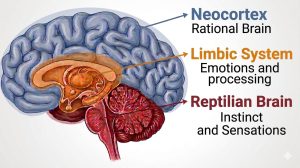 1. The “Bottom”: Bodily sensations and Limbic Brain (emotional mind)
This includes the reptilian brain, in which we have the brainstem (survival part that is primarily in charge of involuntary functions—things our body does automatically without we having to think about them), and then the limbic system (regulates and process emotions).
- These areas of the brain are non-verbal, they don’t communicate through words; they speak the language of sensations (tightness, heat, tingling) and impulses (the urge to run, hide, or please).
- When we use Somatic Experiencing or Brainspotting, we are starting here.
2. The “Up”: Prefrontal Cortex (logical mind)
This is the “Top”—the rational, logical part of the brain that handles language, planning, and “understanding.”
- In traditional talk therapy (Top-Down approach), we tried to use the Top to calm the Bottom. But when the Bottom is in a Freeze or Fight state, it often “unplugs” the Top, which is why logic doesn’t work during a panic attack.
The Bottom-Up Flow
In Bottom-Up processing:
- We start with a sensation in the body or a Brainspot.
- The subcortical brain (the “Bottom”) finally processes and releases the trapped survival energy.
- The “Up”: Only after the subcortical brain feels safe does it send a signal up to the Frontal Cortex.
- The Result: We finally “understand” or feel differently at a thought level because the physical “threat” is gone.
Bottom-up” means: Body Subcortical brain Cortex
(body -emotional brain -logical brain)
This techniques are totally complimentary and are deeply rooted in the neurobiology of presence, ensuring a safe and resonant space where our nervous system can shift from a defense mode/ survival-based activation to an integrated state of calm. These techniques help reveal and release emotional blockages stored in the body’s cellular memory, facilitating emotional and nervous system balance and the letting go of old reactive patterns and negative beliefs. All of them are based on the latest research in neuroscience, combining somatic awareness with energetic release to restore the natural flow of our life force.